
THE FRONT ROW FOR A NEW MEDIUM
At L1VE, I lead the design department for the next generation of live entertainment on Meta Quest and Apple Vision Pro. I shape product & design strategy, mentor designers, and turn emerging XR technology into intuitive experiences that millions can step into.
„Even the most perfect reproduction of a work of art is lacking in one element: its presence in time and space, its unique existence at the place where it happens to be“
Walter Benjamin
A PRODUCT WITH NO PLAYBOOK
L1VE puts you in the front row of live concerts and sport, not on a flat screen, but inside the moment, in a headset. There is no established pattern for how a product like this should look, feel, or flow. Every core decision is a first draft of a convention that doesn't exist yet. As Design Lead, I own design end-to-end and lead the design team behind it, which means three jobs at once: crafting the experience, building the systems that let a growing team move fast, and setting the creative direction that engineering, product design, and brand deliver against.

BUILDING THE FOUNDATION
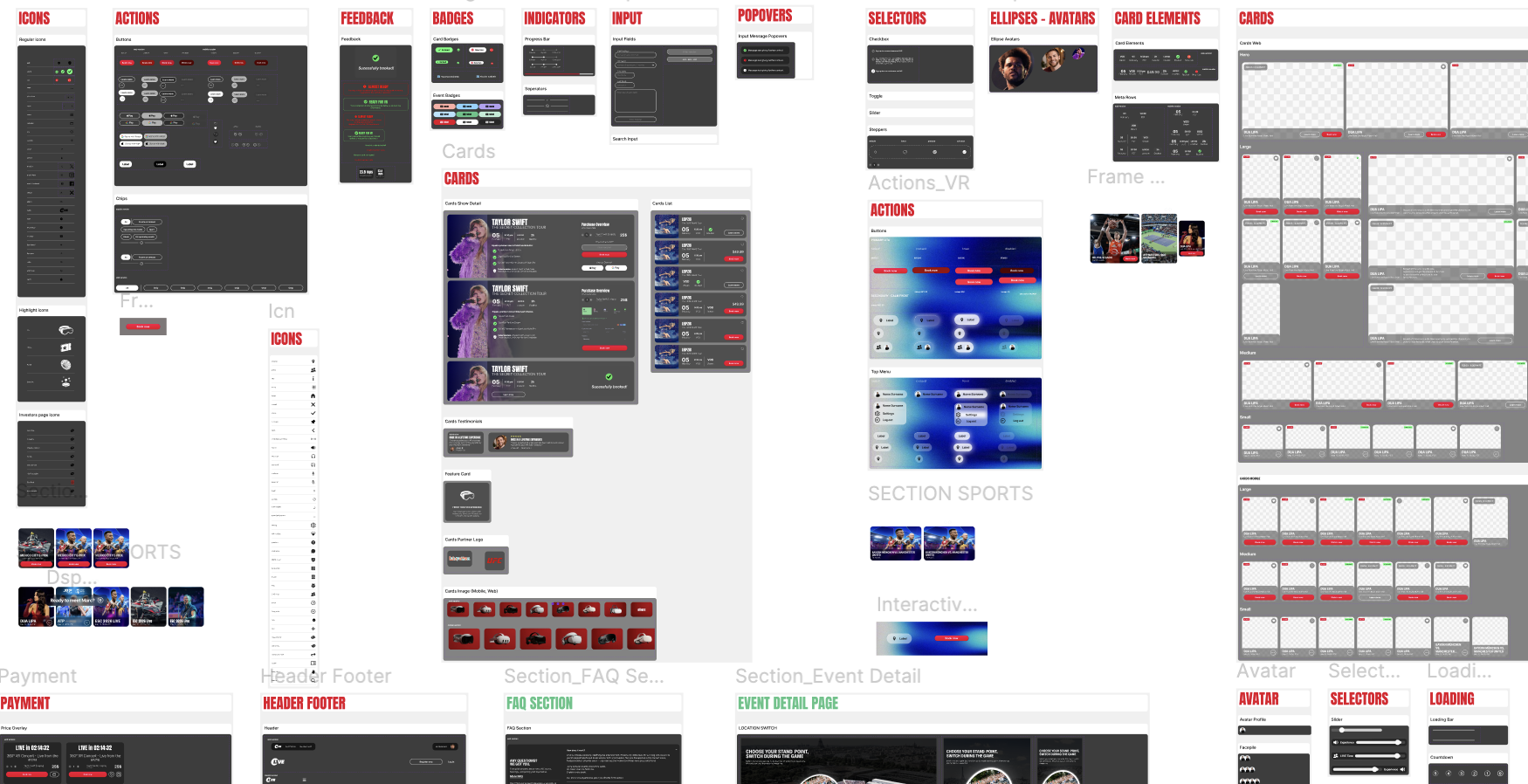
Before a product scales, someone has to build the ground it stands on. I built L1VE's design system and component library in Figma, modular, section-based components where one change propagates everywhere, instead of forcing manual edits across dozens of screens.
Alongside it I authored our Design Process & Structure: not just how work flows from concept to handoff, but the design philosophy and decision rationale behind the product, a reference any new designer can read to understand why things look and behave as they do. And I established the review cadence and feedback culture that keeps a scaling design team aligned without slowing it down. This is the part most skip and the part that actually compounds: structure that lets other people do their best work.

From Status Symbol to Urban Building Block
Today, the car is simultaneously a means of transport, a status symbol, and a vacant private space — inefficient, expensive, and isolating. But emerging technologies such as modular vehicle architecture and artificial intelligence now make it possible to separate space from mobility. This lays the foundation for entirely new, shared infrastructures in urban environments.
A Day in the Life of a numen
To illustrate the system, I developed the scenario “A Day in the Life of a Platform”:
Freshly cleaned and fully charged, the platform leaves the depot in the morning. Initially equipped with a transport module for individual public transit, it carries out pre-booked trips for commuters. Empty runs are rare, overcrowding never happens — instead, familiar faces appear on recurring routes. By 10 a.m., everyone is at the office.
Next, the platform automatically moves to another part of the city. In an underground facility, the transport module is swapped for a workspace module — and sent to a school in an underserved neighborhood, where temporary morning classes take place.
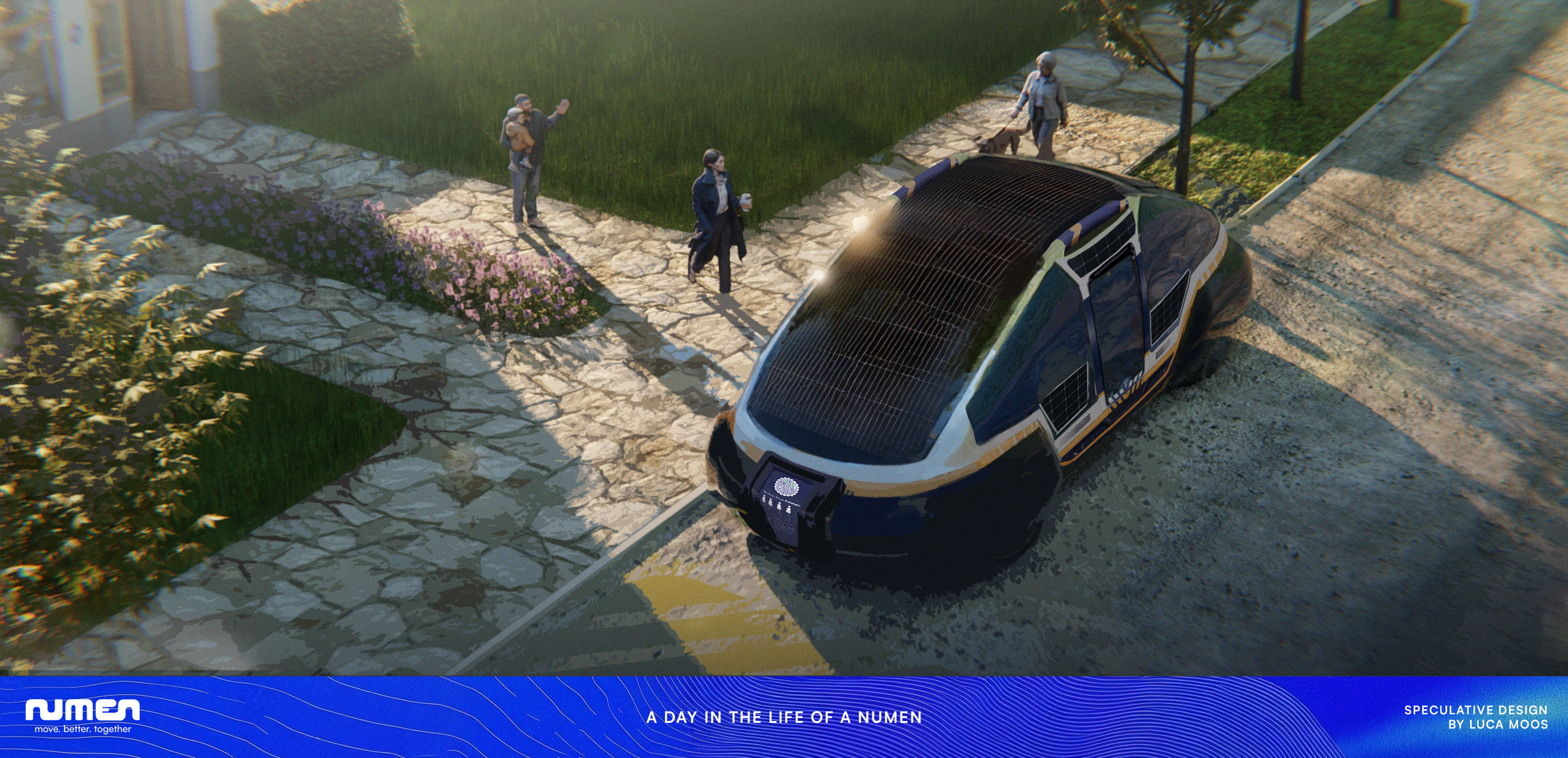
Afterwards, the platform picks up a small group of digital nomads heading to the outskirts for meetings and a few hours of collaborative work. During this time, the platform remains stationary. During the day, the platform changes its function multiple times — in one of the many underground facilities strategically distributed across the city. Its operations adapt dynamically to current demand. The city’s AI coordinates all routes, swaps, and deployments to keep energy consumption and idle time as low as possible.

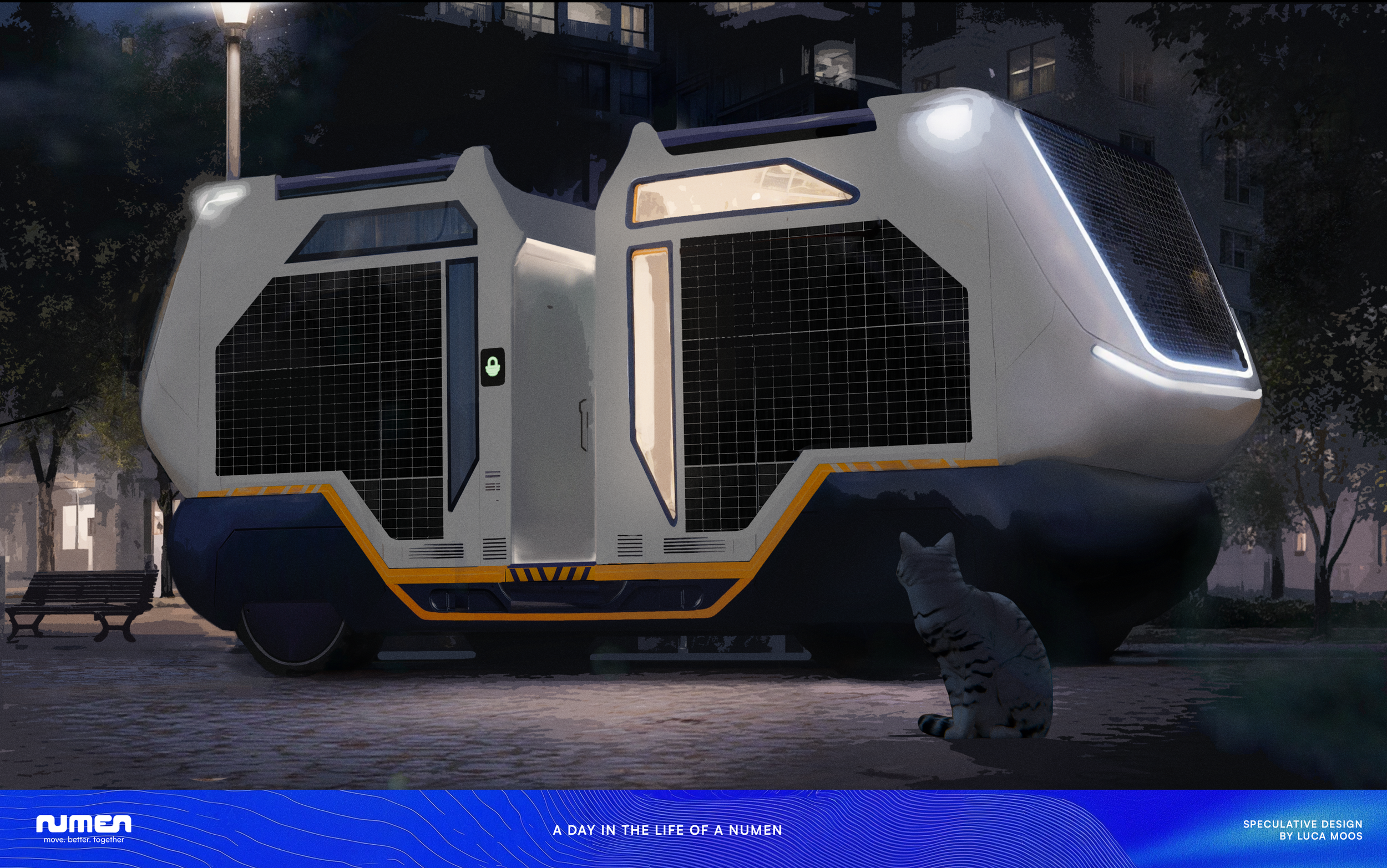
In the evening, the platform returns to commuter service: bringing people home from work or to cultural events. In the late hours — especially during the colder months — the city AI detects unused capacity and strategically swaps transport modules for housing modules for people experiencing homelessness: mobile refuges that are safe, heated, and dignified.
Just before sunrise, the platform returns to the depot — cleaned, serviced, and recharged — ready for another day in the service of the city.
In this way, the city begins to belong to its people again — shaped by care, community, and the shared desire for a better future. Streets breathe, public spaces open up, and movement becomes effortless and fair.
In the following, we look at the numen app — the digital heartbeat of this new urban life. It connects citizens with the platforms that serve them, orchestrates every journey with precision and empathy, and weaves together the spaces, services, and moments that make a city feel alive.
Connecting human needs with urban intelligence
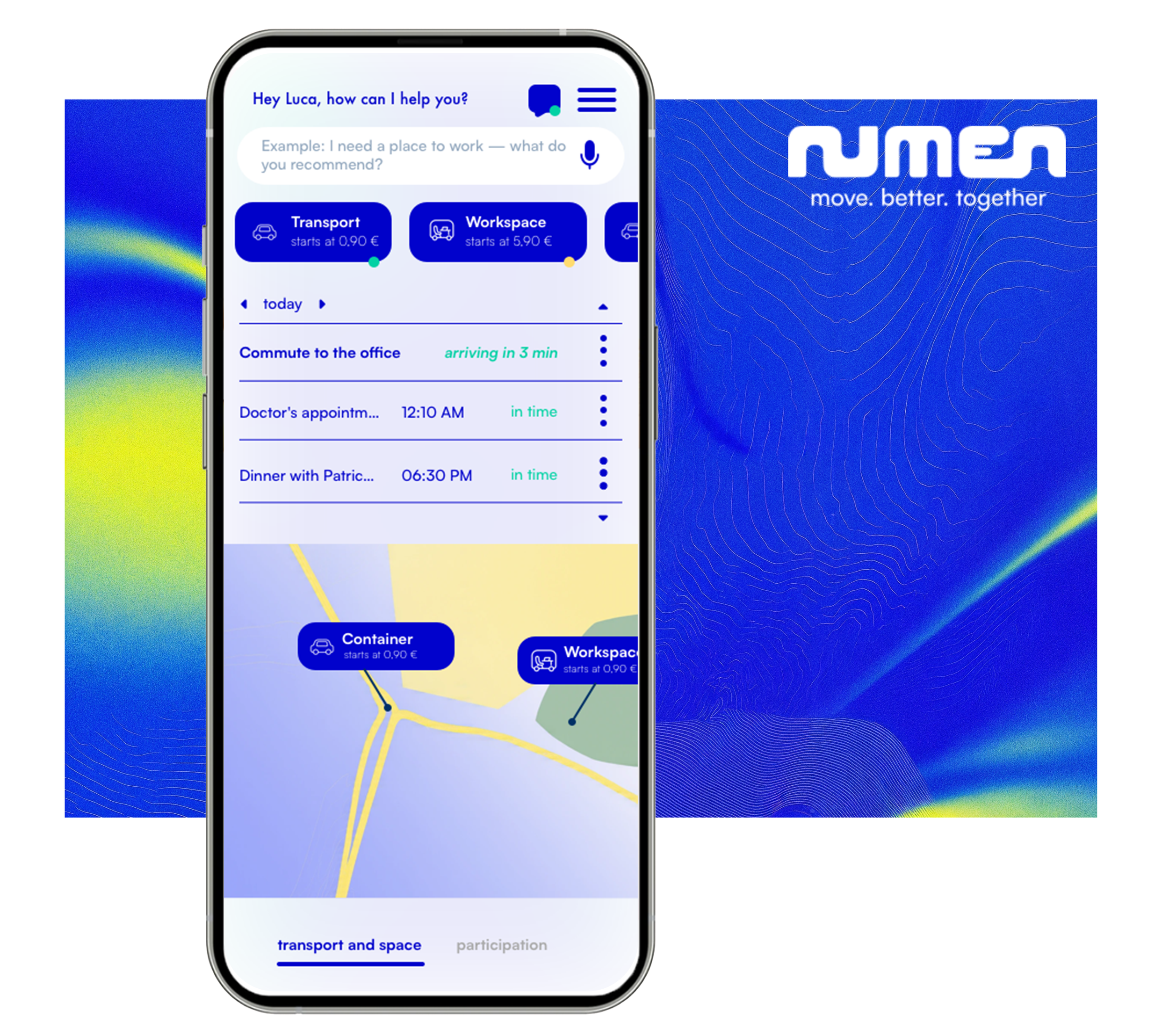
The numen app is the central touchpoint between citizens and the city’s mobile infrastructure.
It allows users to request, book, and customize modules in real time, join community votes for new ideas, and see transparent updates on availability and usage. Fully integrated with the city’s AI, it coordinates needs, prevents misuse, and ensures that every platform and module serves the common good — accessible, intuitive, and designed for everyone.
Ordering a Transport Numen – Seamless, Adaptive, People-Centered
The ordering process for a transport numen is designed to be as fluid and adaptive as the system itself. From the moment you open the numen app, the interface guides you with clarity and minimal friction. You simply enter your destination or select from your personal mobility history. The system instantly presents available ride options — from standard shared cabins to private modules or configurations with extra luggage space.
Once you confirm your choice, the numen platform dynamically assigns the optimal autonomous platform, ensuring it’s positioned at the right place at the right time. The app doesn’t just summon a ride; it connects you to a shared, adaptive mobility ecosystem. Routes are optimized in real time, empty runs are avoided, and resources are shared across the network. Whether you’re commuting to work, traveling with family, or transporting goods, the order process makes mobility feel like public space: available, responsive, and centered around people rather than vehicles.

Booking a Workspace Numen – Flexible Space, On Demand
The booking process for a workspace numen begins just like any other module request in the numen app: simple, fast, and adaptive. After logging in, you select “Workspace” from the available module categories. The interface presents you with real-time availability, showing nearby autonomous platforms equipped for focused work — featuring desks, connectivity, climate control, and sound insulation.
You choose and, once confirmed, the numen system dispatches the nearest suitable platform to your location or reserves a spot at a desired destination. The module arrives ready for use, ensuring that your working environment matches your needs exactly — whether you’re preparing for a meeting, hosting a brainstorming session, or just need a quiet space in the city.
Because numen is more than just transport, it offers a wide variety of modules — from learning spaces to healthcare cabins, from shelters to leisure zones. The UI for each booking flow must be tailored to the specific needs of its users. In the future, it’s conceivable that numen could design these interfaces dynamically, based on observed user behavior and preferences, pre-creating them with AI and then having them reviewed and approved by a human to ensure quality, usability, and trust.

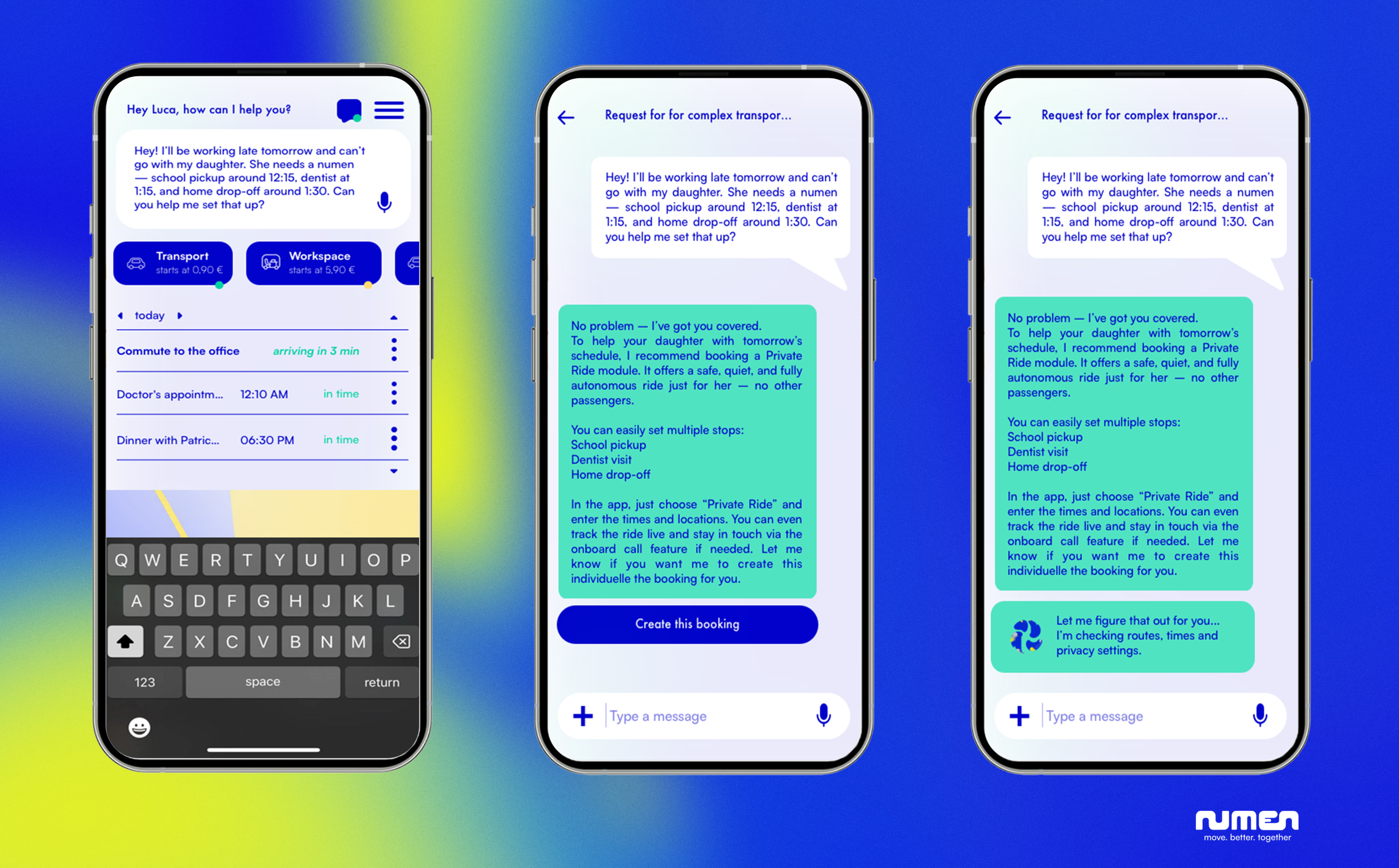
User Story: AI-Driven Booking Flow for Safe, Personalized Transport
From request to confirmed multi-stop trip in seconds – a proactive, privacy-first mobility experience.
In this example, the user simply describes a multi-stop trip for their daughter. numen interprets the request, selects the safest option (Private Ride), and generates a complete itinerary in seconds — ready for review or adjustment. The assistant prioritizes safety, privacy, and reliability, offering features like live ride tracking, onboard video calls, and real-time updates.
Beyond transport, numen’s modular system can apply this intelligence to any unit — from workspaces to medical modules. In the future, booking flows and UIs could be auto-generated by AI, pre-designed to fit each user’s needs and behaviors, and then human-reviewed for usability, inclusivity, and compliance.
From Confirmation to Real-Time Oversight
Once the booking is confirmed, numen transitions seamlessly into execution and monitoring. The user sees the complete itinerary in their dashboard, with each step tracked in real time. Progress updates are tied to precise map views and status indicators, ensuring clarity at every stage.
For high-trust scenarios like transporting a child, numen offers live interior video feeds, direct communication with the passenger, and instant sharing of the ride status with other caregivers. These features reinforce accountability, transparency, and emotional reassurance — critical for both safety and user confidence.
This flow illustrates how numen’s agentic capabilities don’t end at planning. They extend into continuous, user-centric service delivery, closing the loop from request to arrival. Combined with its modular architecture, the same oversight model can be adapted to any mobility or service module, from medical transport to workspace logistics.

Participatory Urban Decision-Making
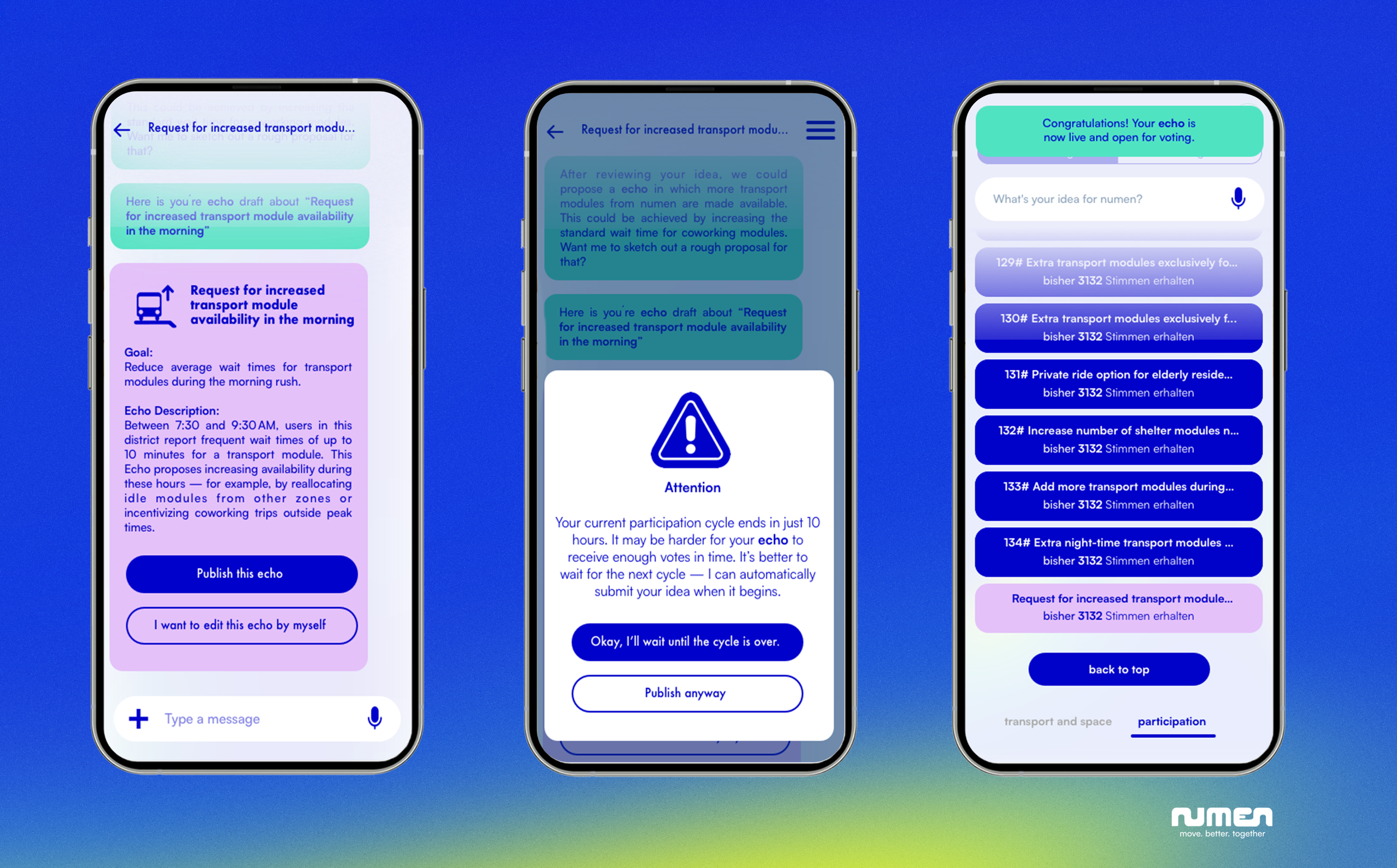
This flow illustrates how numen embeds democratic participation directly into mobility and urban infrastructure. Through the Echos system, users can actively shape their surroundings by voting on local initiatives — from infrastructure upgrades to social support programs. Every vote is counted and displayed transparently, with real-time updates showing the current ranking of proposals. Clear goals, accessible descriptions, and instant feedback after voting make the process intuitive and inclusive. In doing so, numen evolves beyond a transport and service platform into a democratic tool — turning collective decisions into tangible, visible change in the urban environment.

From Ideas to Action — How Numen Turns Citizen Input into Impact
If a user has an idea for an Echo, they can discuss it directly with numen’s AI, which helps refine the concept into a clear, actionable proposal and ensures that numen’s participatory system upholds its core values of fairness, inclusivity, and equal access. When users submit ideas through Echos, proposals that would exclude or favor specific groups are flagged and guided toward more equitable alternatives. The system provides constructive feedback in real time, helping users reframe their suggestions so they align with numen’s democratic principles. By supporting respectful, inclusive idea generation, numen not only protects the integrity of the platform but also empowers communities to collaboratively shape urban mobility and public space in ways that benefit everyone.

Once refined with numen’s AI, a user’s Echo can be published for the community to review and vote on. The system offers guidance on optimal timing to maximize visibility and support, but also allows immediate publication if the user prefers. When live, the Echo is added to the district’s active proposals, giving residents the opportunity to engage, debate, and decide collectively — ensuring that every approved idea has passed through both value-based checks and open democratic participation.
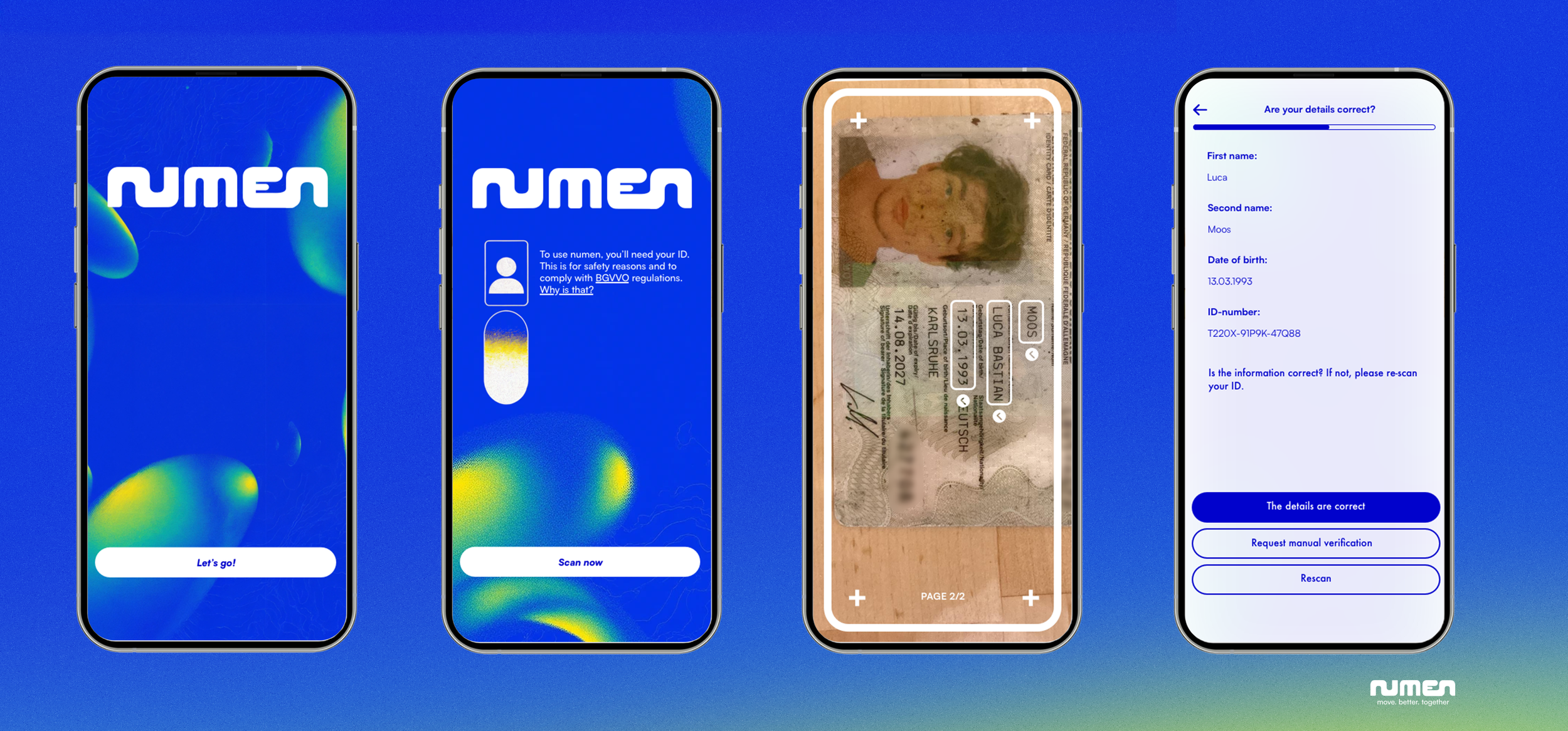
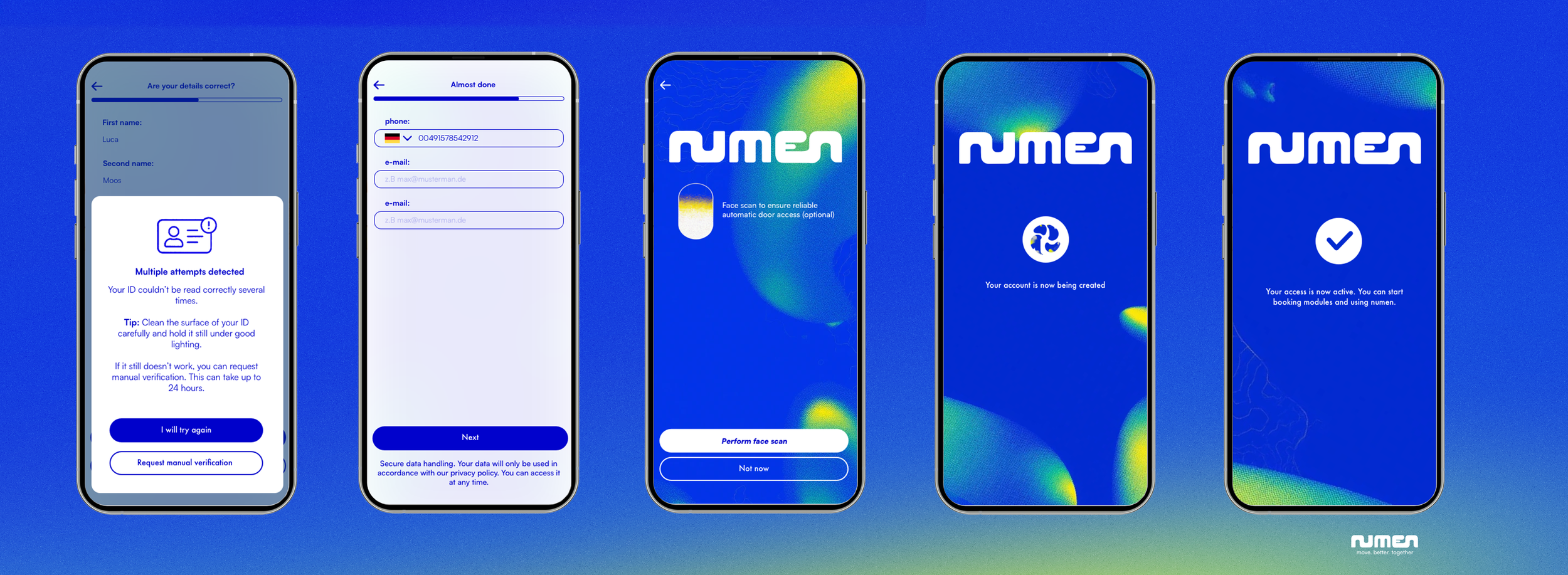
ID Onboarding — Building Trust from the Start
Before a user can access any part of the numen system, they complete a one-time ID onboarding. This process securely verifies their identity and links it to their account, creating a trusted foundation for participation. By making every user accountable from day one, numen can protect shared resources, ensure responsible use of modules, and provide a safer, fairer experience for the entire community.
Reclaiming the City’s Future
numen is more than a mobility system it is an urban strategy for reclaiming public space, rebuilding trust, and rethinking how cities move, grow, and care for their people. By merging autonomous infrastructure, adaptive design, and transparent governance, numen offers a blueprint for mobility that is fair, flexible, and deeply human.
The path forward is clear: a city shaped not by the constraints of traffic, but by the needs and aspirations of its citizens. Streets that invite connection. Infrastructure that listens, learns, and adapts. Mobility as a public good accessible, sustainable, and in constant dialogue with the people it serves.
This is not an abstract vision. Every platform deployed, every journey taken, is a step toward a living urban network where technology and community reinforce each other. numen is designed to evolve with the city to be as dynamic, diverse, and resilient as the people who call it home.
The question is no longer if we can build such a system, but when we choose to make it real.
Get in touch
luca.moos@googlemail.com
+49 1578 5429192
Prenzlauer Allee 26
Berlin, 10405